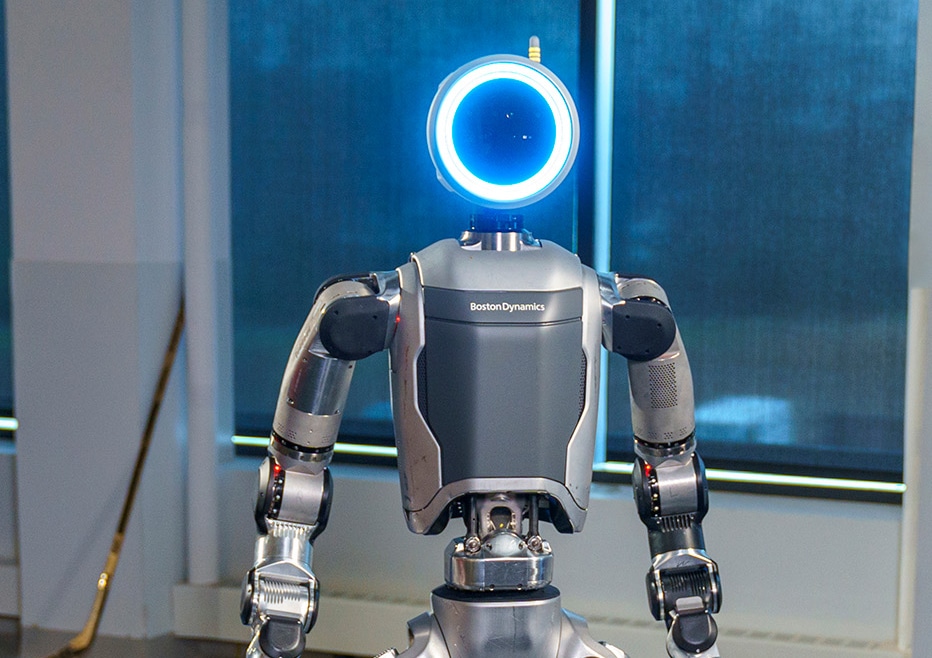
Boston Dynamics markets the product Atlas as an industrial humanoid, extending the story beyond the remarkable movements of its research predecessors. Its partnership with Google DeepMind targets the learning and reasoning needed for useful work. The combination makes a central issue clear: walking is a means of reaching a task, not the task's final result. A factory does not primarily need a robot that can traverse an aisle. It needs the correct object moved, positioned or handled without disrupting the surrounding operation. Boston Dynamics Atlas product; Boston Dynamics and Google DeepMind partnership.
Locomotion and manipulation meet at the workstation
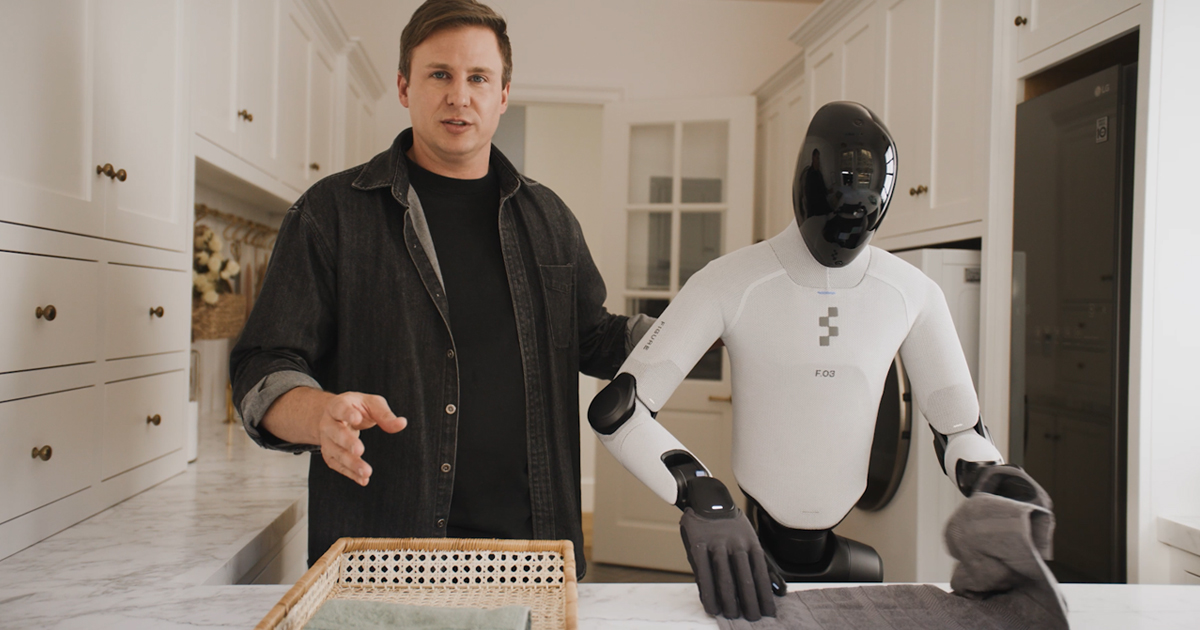
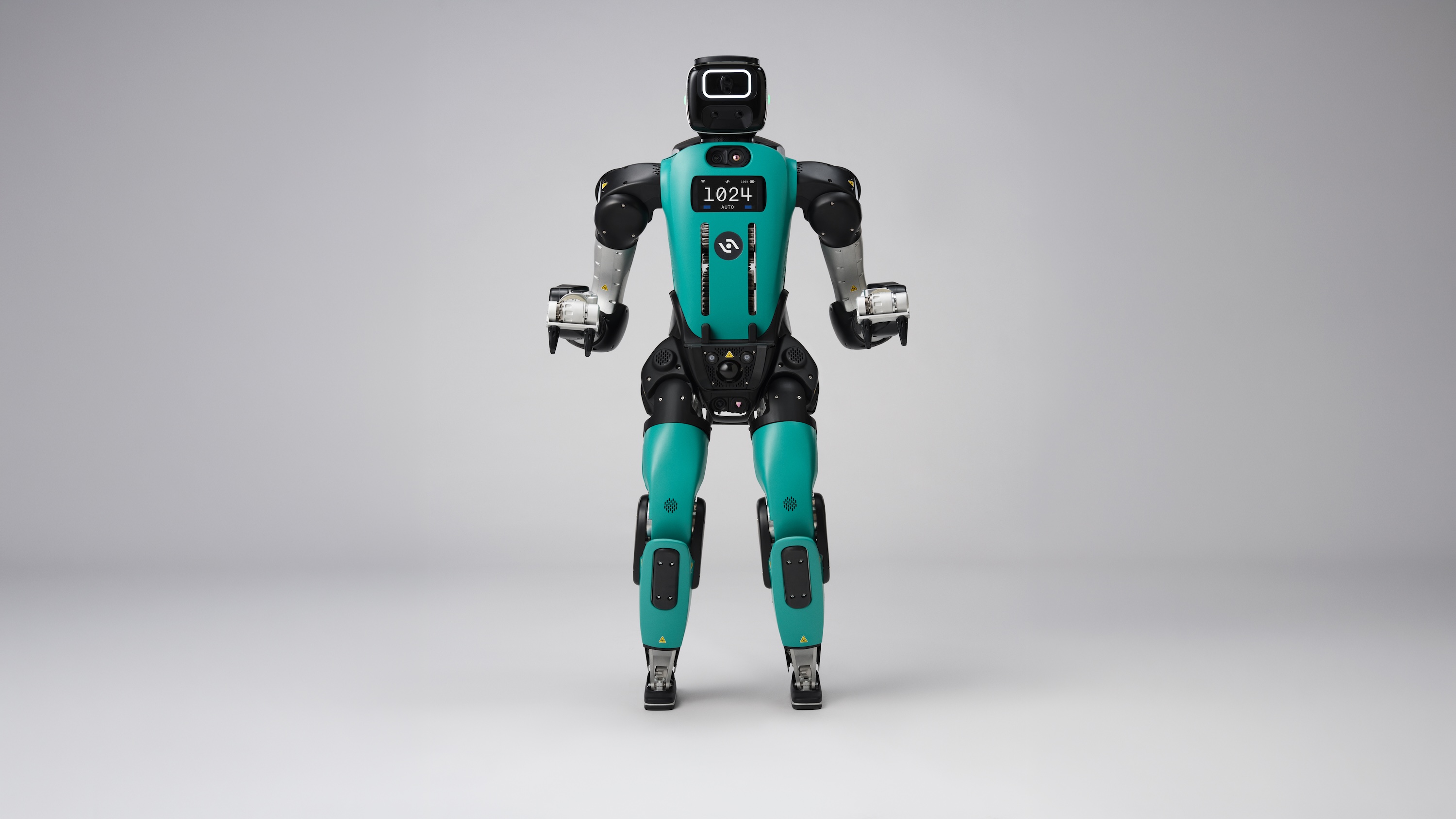
A robot may need to change stance to reach a component, move its torso to see around an obstruction or reposition while keeping a load stable. Treating walking and arm movement as entirely separate skills can make those transitions awkward. Figure's January 2026 Helix 02 announcement similarly emphasizes full-body control, showing that whole-body coordination is a shared development target across different humanoid programmes. The announcements establish the direction of the work; they do not prove identical capability or reliability between the platforms. Helix 02 full-body autonomy, January 27, 2026.
The transition from travel to work can be more demanding than either stage alone. A machine arrives at a station with some uncertainty in its position, then has to align its hands with a much more precise target. It may need to observe again, adjust its footing and confirm the object's pose. Those steps consume time, but they can be essential to reliable execution. A demonstration that begins with the robot perfectly positioned removes part of the real job. A demonstration of walking that ends before manipulation removes another part.
Human spaces contain implicit rules
An aisle is not simply free geometry. People use it to communicate intent, pause, carry materials and give way. A humanoid must fit into those patterns or the workplace must create explicit rules around it. Physical clearance is only one requirement. Predictability also matters: colleagues need to understand whether the robot will continue, stop or turn. Sudden but technically collision-free movement can still make shared work difficult. The product's behavior should therefore be evaluated in the presence of ordinary human activity, not only against static obstacles.
The human shape offers potential advantages where tools and workstations already assume human reach and height. It also brings costs, including balance and the interaction between a carried load and the body. Those costs are justified only where the resulting flexibility is useful. A wheeled platform or fixed arm may be better for a simpler route and task. The comparison is not a contest of appearance. It is a question of how much environmental adaptation each solution requires and how reliably it performs the complete work sequence.
The useful evidence crosses the transition
A convincing industrial result follows the robot from its initial location through travel, alignment, manipulation and recovery. It identifies which parts were autonomous and which required setup or assistance. It should also include the circumstances in which the robot declined to proceed. A well-timed refusal can protect people and workpieces, but frequent refusals may limit capacity. Atlas' industrial positioning raises the right standard for this evidence. The relevant achievement is not merely more capable walking; it is a dependable connection between mobility and useful action in a workplace that continues operating around the robot.
A robot walking across a clear floor demonstrates a real capability. It does not yet demonstrate mobility as a working service. A humanoid may need to carry an object, yield to another worker, negotiate a changed route and arrive in a position from which the next task can begin. Boston Dynamics introduced an all-electric Atlas in 2024. Boston Dynamics introduces electric Atlas.
Test movement with the task attached
The test should attach movement to that larger purpose. Walking speed without a load may be less relevant than the time required to deliver a part without disturbing it. Turning in a narrow aisle may matter more than maximum stride length. The workplace determines which combinations deserve measurement.
Variability should be introduced deliberately. A route can include a temporarily unavailable destination or an object presented slightly differently from the previous attempt. The aim is to learn whether the system recognizes the change and responds within its permitted operating limits, rather than merely repeating a rehearsed sequence. NIST's robotics programme develops performance measures and evaluation methods. NIST measurement science for robotics.
Make recovery visible
Human interaction needs the same attention. Workers should be able to understand where the robot intends to move and how it will yield. A system that requires everyone nearby to guess its next action may create support work even when its navigation algorithm avoids collisions in the test.
The strongest mobility evidence follows the complete journey and records interruptions, assistance and final placement. That connects the engineering achievement of walking to the operational achievement of moving work through a site. It also makes clear where the current capability ends and further development is still required.
Load variation is another important boundary. A robot may walk reliably when empty and face a different balance problem when carrying an awkward object whose center of mass is uncertain. The task-level evaluation should include the range of permitted loads and how the machine responds when it cannot establish a secure hold. That is not simply a payload specification. It is a test of the connection between perception, gripping, balance and the decision to proceed, which is exactly where the humanoid form promises flexibility.
Sources & evidence
This archive preserves its original editorial date. Sources describe the events and announcements discussed; they do not establish today’s status.