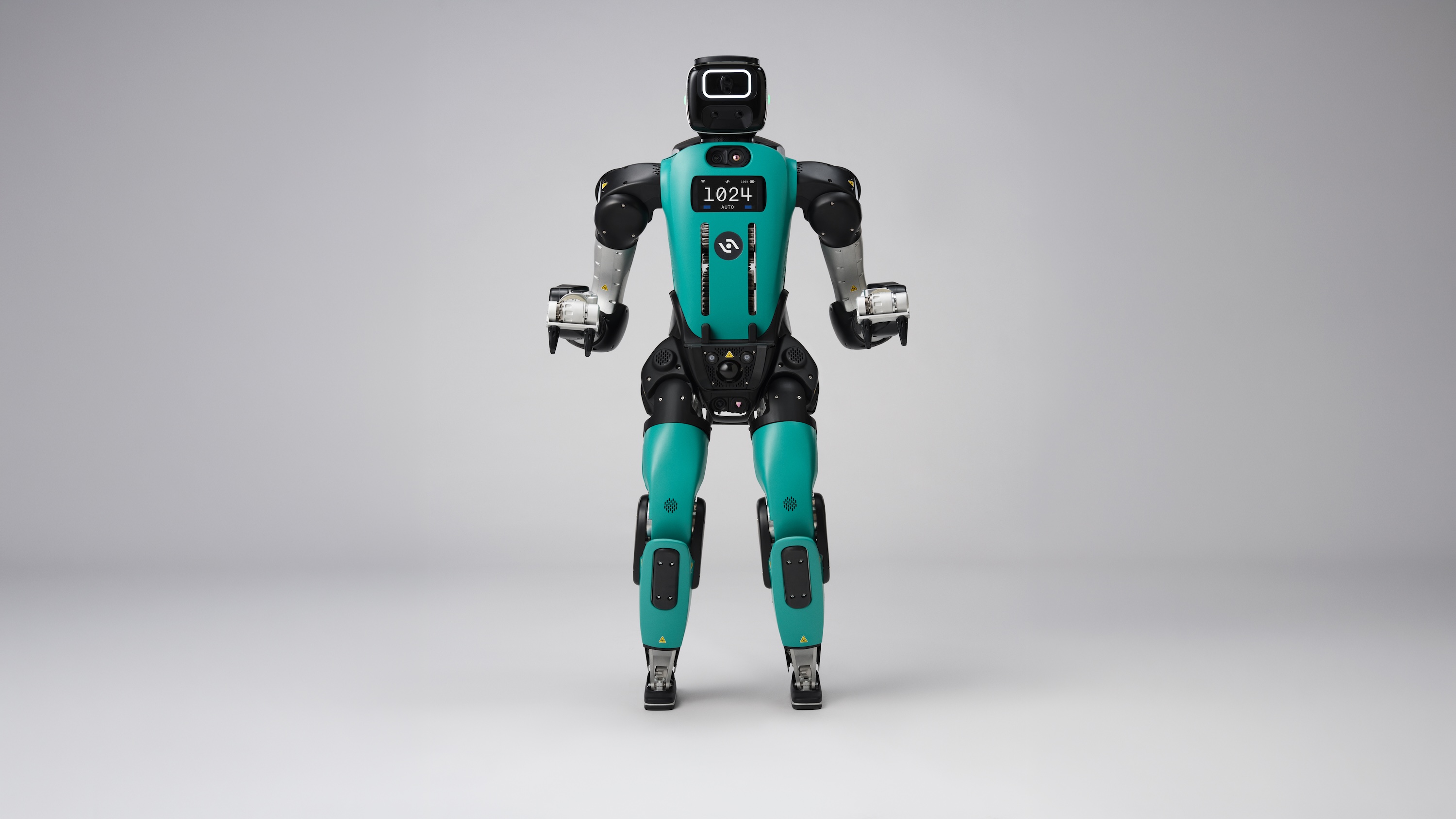
Agility's GXO deployment places Digit within a commercial service relationship rather than a simple demonstration of a robot for sale. Its Digit 5 roadmap proposes a wider range of work, while the current product description emphasizes the surrounding deployment system. These developments make the economic question more concrete: how much dependable work can the customer obtain, after accounting for the people, equipment and process changes needed to keep the robot useful? Agility's GXO deployment account; Digit 5 product description.
A robot is not a unit of labor capacity
Two installations of the same hardware can produce very different results. One may have steady demand and predictable inputs; the other may spend much of the day waiting or recovering from exceptions. The purchase or subscription price does not capture that difference. A useful comparison relates total cost to completed work of acceptable quality. It includes setup, training, supervision, maintenance, energy and the cost of handling failures. Omitting those categories can make a low-priced robot appear economical while hiding a large support burden.
Agility's October 2026 agreement with FORT illustrates one part of that surrounding system: external safety interfaces and deployment support. The memorandum is a plan for a deeper partnership, not a guarantee of a particular customer's savings. Its relevance to economics is that safe integration is necessary work. A robot that cannot be operated reliably within the facility's safety arrangements cannot deliver its advertised capacity. Treating that work as separate from the robot's cost would make the comparison incomplete. Agility and FORT partnership, October 1, 2026.
Utilization has to be earned
A general-purpose body could, in principle, move between tasks and spend less time idle. In practice, each task needs suitable skills, tools, permissions and integration. Changing jobs may require travel, a different end effector or a new validation process. The economic benefit depends on how much useful work remains after those transitions. It should not be calculated by assuming that every unoccupied minute can automatically become productive labor on another task.
Reliability has a similarly nonlinear effect. A small number of exceptions can be manageable if they are predictable and quick to resolve. The same number can be costly if each interrupts another worker or blocks a production line. Counting interventions is useful, but their duration and consequence matter too. A robot that asks for help early may have a better total outcome than one that attempts recovery repeatedly and eventually creates a more difficult problem. The economics depend on the whole response, not simply on whether the machine ever needed assistance.
The right comparison is a defined alternative
A customer should compare the humanoid with the realistic way the task would otherwise be done: people, fixed automation, a wheeled robot or a revised process. Each alternative has its own setup and operating costs. The humanoid's flexibility is valuable only where the workflow uses it. GXO's bounded deployment provides a more useful starting point than an imagined universal worker because the task and service can be examined. The sector's economic case will strengthen through such specific comparisons, with actual utilization and support data replacing arithmetic based on an uninterrupted theoretical working day.
A purchase price or service fee tells a buyer what the supplier charges. It does not tell the buyer what it costs to obtain a completed task. Humanoid economics depend on the relationship between output and the resources required to keep the machine producing that output. GXO and Agility announced a multiyear Digit deployment agreement in 2024. GXO and Agility commercial agreement.
Choose the denominator carefully
The denominator should be work that meets the receiving process's requirements. A moved object is not necessarily a completed delivery; a placed part may still require correction. Counting accepted output makes quality and recovery visible and prevents a fast but frequently interrupted sequence from appearing artificially productive.
The numerator should include site-specific preparation, integration, supervision and maintenance, along with the commercial charge. These categories are an analytical framework, not a price estimate. Their size needs evidence from the intended deployment, because support arrangements and operating conditions vary. NIST's robotics programme develops performance measures and evaluation methods. NIST measurement science for robotics.
Show assumptions instead of a headline
Comparisons should also identify what changes around the robot. A process redesigned to make automation easier may be worthwhile, but the redesign belongs in the evaluation. So does any work transferred to another team. A reduction in one visible activity is not automatically a reduction in total organizational effort.
The most useful business case is transparent enough to update after a trial. It shows measured output, observed assistance and explicit assumptions about future performance. That lets a buyer distinguish value already demonstrated from value that depends on further engineering, greater scale or a different operating arrangement.
Costs should be associated with the same time period as output. A brief demonstration can omit scheduled service, staff retraining and the effort required after an update. A longer observation period may reveal those recurring costs and also reveal benefits that a short test misses. The objective is not to make every estimate pessimistic. It is to use a comparable basis, so a customer can see which assumptions drive the result and which improvements would make expansion worthwhile.
Sources & evidence
This archive preserves its original editorial date. Sources describe the events and announcements discussed; they do not establish today’s status.